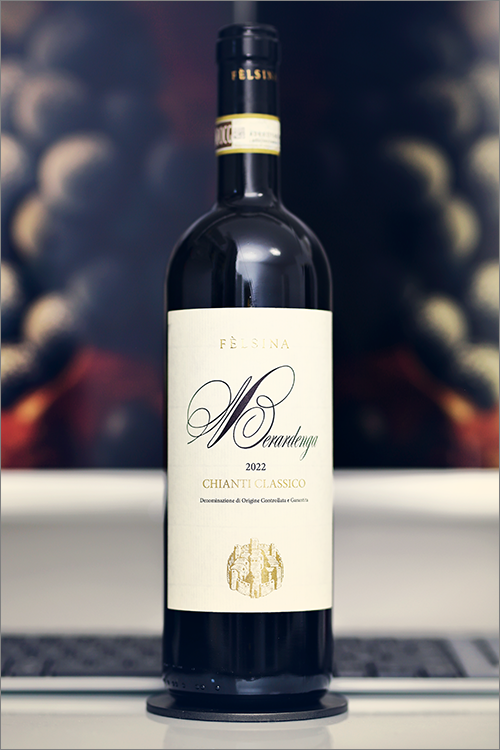
FÈLSINA | Berardenga | Chianti Classico | 2022
sangiovese
 © We will be evaluating wines in no particular order on no particular schedule. Just stay tuned and you will never miss our reviews. If the wine is tasted more than once, the rating table will be updated so as to reflect all the new impressions and observations. We hope you will enjoy it!

The Fèlsina winery, nestled in the heart of Tuscany, holds a rich history dating back to its origins as a farm for the Grand Dukes, predominantly dedicated to olive groves. It was in 1966 that Domenico Poggiali Fèlsina, with a pioneering spirit, acquired the property during a challenging period for italian viticulture. His vision was clear: to invest in the unwavering quality of the wine and to express the multifaceted terroir of Tuscany. This ethos saw the estate embrace modernity without abandoning its deep respect for tradition. By the late 1970’s Domenico initiated the collaboration with Giuseppe Mazzocolin, Luigi Veronelli, and renowned oenologist Franco Bernabei, who collectively refined a visionary developmental strategy that came to fruition with the landmark 1983 vintages of Fontalloro and Rancia. Further enhancing their commitment to precision and quality, Giovanni and his father Giuseppe Poggiali introduced stainless steel tanks in 1998, ensuring greater control for winemakers while steadfastly upholding Fèlsina’s core values of balance, consistency, and distinctive style. Today we are going to review a single-varietal sangiovese wine from one of the Italy‘s most iconic wine regions, the mighty Tuscany – Berardenga Chianti Classico 2022 by Fèlsina. Chianti wines can be made with grapes sourced from a vast region within Tuscany – from the foothills of the Apennine Mountains, to the flatter plains towards the Mediterranean Sea, but, in order to taste some of best expressions of sangiovese-based Chianti wines, one needs to look into higher elevations, towards the original boundaries of the Chianti region, called Chianti Classico, where wines are made in smaller quantities, with lower yields and therefore are of higher quality. The best wines from Chianti Classico will be labelled ‘Riserva’ or ‘Gran Selezione’. Wines from the historic Chianti Classico appellation can be identified by the
 Gallo Nero symbol – the Black Rooster – the historic emblem of the Chianti Classico Consorzio and a guarantee that the wine comes from the defined Chianti Classico production zone. The symbol has become one of the most recognizable marks of quality and authenticity for Chianti Classico wines. 
Today’s wine is crafted with 100% sangiovese grapes, sourced from the vineyards that are located in Castelnuovo Berardenga, in the southeastern part of the Chianti Classico appellation, to the southeast of the town of Siena. All the vineyards have a southwestern exposure, sprawling across ventilated slopes at an altitude ranging from 320-420 meters above sea level. Geologically, the soils vary from predominantly rock quartz and calcareous alberese mixed with alluvial pebbles in the higher parts, and strataform sandstone with loam for the vineyards on the edge of the Colli Senesi. After gentle destemming and pressing, the grapes were fermented at controlled temperatures, with a period of extended maceration in stainless steel tanks to extract color and flavor depth. The wine then ages for 12 months in a combination of medium-sized slavonian oak barrels (a secular tuscan tradition), with a small proportion aged in second and third-fill small, french oak barriques, before being assembled, bottled, and aged for a at least 3 more months in the bottle.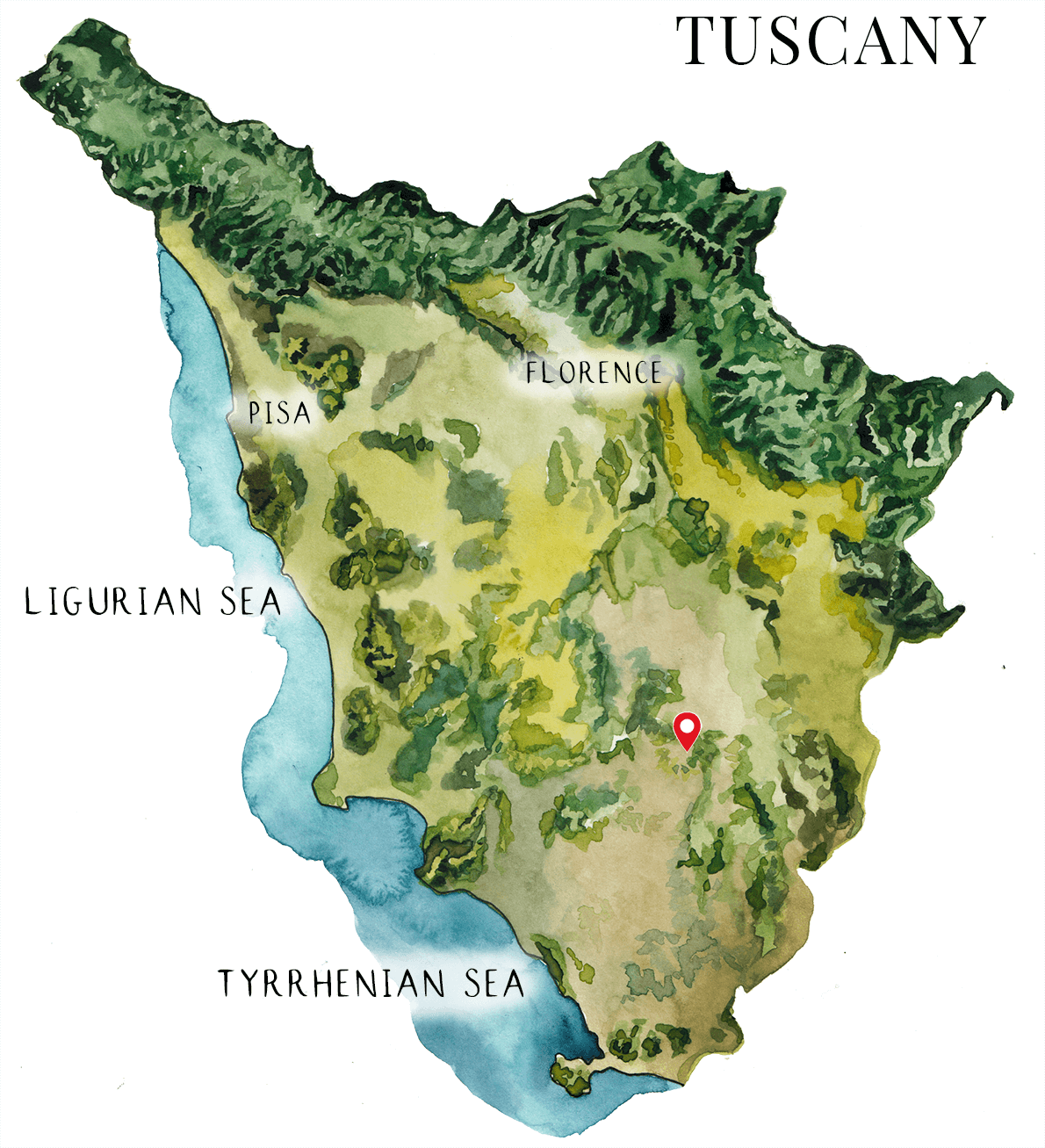 Until relatively recently, Sangiovese was considered to be a grape in the wilderness – rustic, delicate and savory, and whenever the name sangiovese would appear on a label, it was far from a guarantee of quality. But sangiovese is the dominant red grape of Italy, effortlessly adapting to each particular terroir where it is planted. In that sense, it can vary as much as pinot noir in its sensitivity to the place it is grown in, and like pinot noir, it ripens relatively late. This means that if it is planted in a cooler climate, sangiovese can produce wines that are dangerously tart and green, but when ideal growing conditions are met (mainly high diurnal range and a prolonged growing season),sangiovese is capable to produce wines that would lead you into the realm of perfection. With numerous mutations spread all over Italy, this versatile grape variety can create wines with strikingly diverse flavor profiles: from the delicate and floral Montefalco Rosso, to the bold and tannic wines of Brunello di Montalcino. The one thing that the sangiovese grape variety cannot hide is its flavour profile, but now that the right clones have been identified and are increasingly popular, sangiovese is allowed to shine in all of its glory.

Toscana wine region has long boasted an impressive reputation in the world of great wines, earning its prestige as one of the most promising and creative production areas in the world of wine as a result of a number of forward-thinking producers that experimented with international grape varieties and modern winemaking techniques. Toscana (or Tuscany) is home to some of the world’s most famous wines – the mighty ‘Super Tuscan‘ wines.
 The Chianti wine region is renowned for its diverse terroir, characterized by rolling hills, very warm summers, and mild winters, providing ideal conditions for grape growing. The soils composition differ vastly, from rocky and well-drained soils around the region’s highest hills, to fertile clay-based soils at lower altitudes, supporting various root systems that enhance vibrant fruit expression. Those diverse microregions allow the winemakers to experiment with different plots in order to build a wine that truly reflects their vision or wines that are capable to reflect the footprints of local terroirs.
 The Chianti Classico DOCG is the historic heart of the Chianti wine region, located between Florence and Siena and recognized by its famous Gallo Nero symbol. The region is characterized by steep hills, higher elevations, and a cooler climate than many surrounding sub-regions, with warm summers, mild winters, and significant diurnal temperature variation that helps preserve acidity during ripening. Its soils are ranging from galestro and alberese to limestone, marl, and clay, with the poor rocky sub-soils on the hillsides producing more structured wines. Sangiovese is the region’s champion grape that forms the foundation of Chianti Classico, producing wines with bright acidity and firm tannins, making Chianti Classico one of Tuscany‘s most important regions for terroir-driven red wines.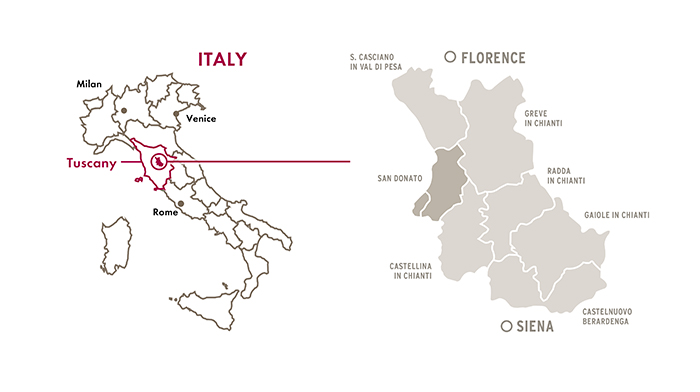

color: medium-pale garnet color
clarity: hazy & noble copper hues
In the glass, the wine presents a medium-deep garnet color, with delicate, hazy copper shades at the rim of the glass.

intensity: rich & savory
fruit character: dehydrated
The aromatic profile is a symphony of richness and delicacy, unveiling a rich and savory nose with a dehydrated fruit character. The foreground bursts with an array of dried red fruits, including sour cherry, kirsch cherry, cranberry, redcurrant, and red plum, intertwined with an appealing bouquet of mediterranean herbs such as basil, thyme, rosemary, bay leaf, and sage. These bright primary layer is complemented by rich touches of dehydrated olive and the subtle influence of sun-dried oakwood. As the wine breathes it unfolds in the glass with a sophisticated background, layered with inviting oak and spices notes like cloves, anise, nutmeg, and a whisper of tobacco. This is further deepened by savory-earthy undertones of loam, marl, clay, and dust, with elegant nuances of toasted oakwood, subtle hints of red pepper, and a delicate, lingering hint of balsamic vinegar, showcasing remarkable aromatic depth and evolution.

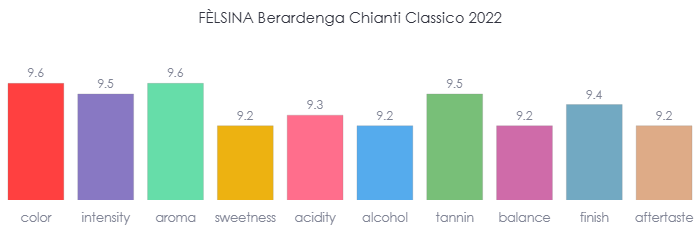
sweetness: dry | acidity: high | alcohol: high | tannin: high | balance: good
finish: medium+ | aftertaste: bitter-seedy & slightly-heady
On the palate, this wine reveals a crisp, warm, and heady tasting experience. It has a pleasantly bitter-seedy mouthfeel that immediately denotes a well-structured and authentic Sangiovese profile. This is a wine deeply rooted in varietal expression and its unique terroir footprint. The mouthfeel is dry, charged by an exuberant acidity that provides lively freshness, perfectly balanced by a noticeable, yet well-integrated, touch of alcoholic warmth. The tannins are firm, seedy, and possess a pleasant astringency, contributing to the wine’s robust backbone without being overwhelming. This culminates in a long, crisp, and distinctively bitter-seedy aftertaste that cleanses the palate and invites further contemplation, highlighting the wine’s intrinsic honesty and rustic charm.

maturity: in its prime or thereabout | drink today or within the next 2 years
verdict: fine | an excellent wine | a wine of premium quality with good potential
Overall, this is a compelling and honest expression of a Chianti Classico from Castelnuovo Berardenga. It reveals a slightly austere and sharp character, balanced by an appealing bitter astringency on the palate. While it presents as a firm and grippy single-varietal Sangiovese, focused on varietal character rather than intricate nuance, it embodies a warm, bright, and rustic charm. The oak influence is well integrated, providing structure and subtle spice without ever overshadowing the grape’s inherent identity. This is an old-world styled, blueprint Chianti wine that feels rustic and crisp, that evoke a genuine, old-school tradition. It is a wine that offers a true taste of its origins, designed for those who appreciate varietal honesty and the distinct voice of its terroir. The wine can be enjoyed today or within the next two years, during which it holds some potential to develop subtle tertiary flavors, adding another dimension to its already engaging personality. All in all, this is a compelling, terroir-driven Chianti Classico that embodies rustic charm and varietal honesty.

Given its exuberant acidity, firm structure, and savory-earthy undertones, this is an incredibly versatile wine. For a truly authentic tuscan experience, pair it with traditional pappa al pomodoro (a rich tomato and bread soup), or a classic pappardelle al ragù di cinghiale (wild boar ragu). The wine’s vibrant acidity will effortlessly cut through the richness of the sauces and meat, while its dried red fruits notes, mediterranean herbs, and savory-earthy undertone will complement the rustic, savory flavors of the dishes. For a more adventurous pairing, consider a succulent porchetta, where the wine’s astringency will stand up to the fatty, herb-infused pork, creating a harmonious and deeply satisfying gastronomic synergy. Cin Cin! FÈLSINA | Berardenga | Chianti Classico | 2022
variety: sangiovese
country: Italy
region: Toscana | Chianti Classico
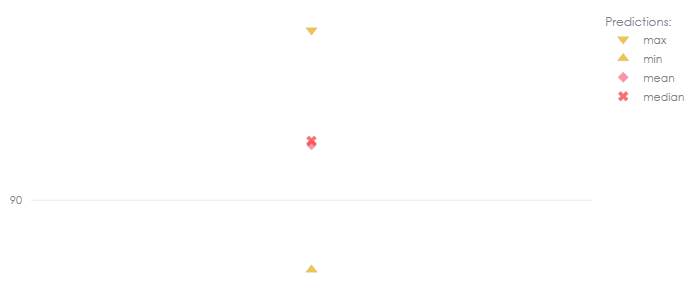
rating: 93.7
The Sangiovese grape in the Chianti Classico region is also known by its ancient tuscan name, ‘Sangioveto’. Recognizing the extraordinary diversity within this single variety, Fèlsina performed an ambitious massali selection program in 1983, in collaboration with the esteemed oenologist Franco Bernabei. This process aimed to preserve a rich patrimony of distinct Sangiovese clones (‘crus’), ensuring their unique genetic material is passed down through next generations. Furthermore, since 1993, Giovanni Poggiali has led an ongoing initiative to replace and plant new vineyards, continually deepening the winery’s understanding and research into Sangiovese grape variety. This commitment reflects a profound belief that terroir, while shaped by geology, is also a living ‘social construct’, constantly evolving through human interaction and dedication.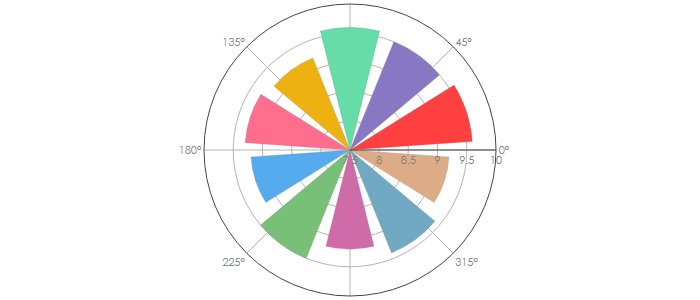
 © The WineStatistics ratings are based solely on our own knowledge of the world of wine and on our personal wine tastes, which may, or may not, differ from yours – the reader. Just remember that there are no absolutes of right and wrong in wine appreciation. Cheers!
Make a one-time donation
Make a monthly donation
Make a yearly donation
Choose an amount
Or enter a custom amount
WineStatistics is a non-profit community. We produce independent and highly detailed wine reviews.
By training ourselves to stop, take a breath, and pay attention to the subtle elements that distinguish one wine from any other, we learn an important lesson about life – that it’s worth taking the time to slow down and appreciate things that pleases us, from a glass of wine to a great work of art. It’s a simple way to learn to appreciate the little things in life that may in some small way enhance our enjoyment of every day.
In order to continue our work we need support from people like you. People who appreciate our contribution in spreading wine knowledge and raising wine awareness across the borders.
You may now support us by contributing with a one-time donation so that we can review even more wines.
WineStatistics is a non-profit community. We produce independent and highly detailed wine reviews.
By training ourselves to stop, take a breath, and pay attention to the subtle elements that distinguish one wine from any other, we learn an important lesson about life – that it’s worth taking the time to slow down and appreciate things that pleases us, from a glass of wine to a great work of art. It’s a simple way to learn to appreciate the little things in life that may in some small way enhance our enjoyment of every day.
In order to continue our work we need support from people like you. People who appreciate our contribution in spreading wine knowledge and raising wine awareness across the borders.
You may now support us by contributing with a monthly donation so that we can review even more wines.
WineStatistics is a non-profit community. We produce independent and highly detailed wine reviews.
By training ourselves to stop, take a breath, and pay attention to the subtle elements that distinguish one wine from any other, we learn an important lesson about life – that it’s worth taking the time to slow down and appreciate things that pleases us, from a glass of wine to a great work of art. It’s a simple way to learn to appreciate the little things in life that may in some small way enhance our enjoyment of every day.
In order to continue our work we need support from people like you. People who appreciate our contribution in spreading wine knowledge and raising wine awareness across the borders.
You may now support us by contributing with a yearly donation so that we can review even more wines.
